



T2 Simulate
Physics-based Process Evaluation and Decision Support for Structural Process Improvement
T2 builds validated simulations of the process that supply data sensors cannot measure and test changes before they are built.
Work packages
Results of the first funding phase, by work package.
-
T2.1 Development of a high-fidelity process simulation CAE chain
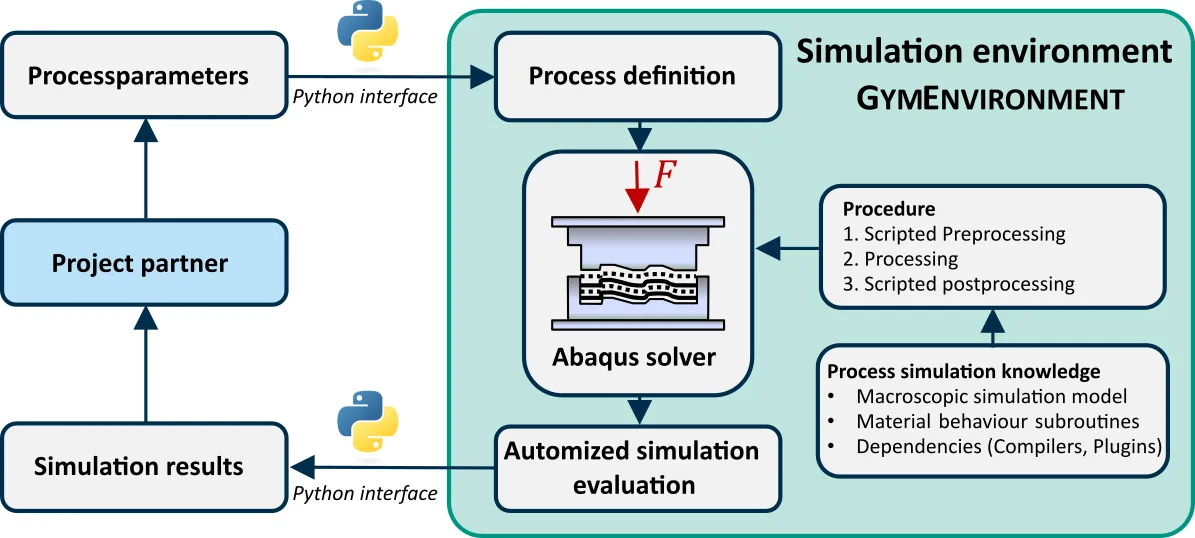
A hexahedral solid-shell element predicts thickness changes in forming simulation. It was extended to rate-dependent material behaviour and applied to stamp forming of thermoplastic tapes. Interpolation methods for fibre orientation tensors reduce information loss along the CAE chain, and the SimEnvironment generates simulation data automatically for the M subprojects.
 Enlarge figure
 Data generation pipeline for stamp-forming simulations with the SimEnvironment, shown under its former name, GymEnvironment. Figure: KI-FOR 5339. Publications
-
3D solid-shell element for macroscopic composite forming simulation enabling thickness prediction
Composites Part A: Applied Science and Manufacturing, 2025
-
Considering the viscoelastic material behavior in a solid-shell element for thermoforming simulation
ESAFORM 2024
-
Composites Part A: Applied Science and Manufacturing, 2026
-
Computer Methods in Applied Mechanics and Engineering, 2024
-
-
T2.2 Development of low-fidelity simulation models
Physics-informed models of the thermal behaviour can partly be trained without simulation data. Fast Python simulations of static problems and nonlinear solid mechanics, simplified forming models and dedicated datasets, including one for a simplified double-dome benchmark, support the development of learned surrogates.
Publications
-
Materials & Design, 2023
-
Computer Methods in Applied Mechanics and Engineering, 2024
-
Swarm Reinforcement Learning for Adaptive Mesh Refinement
NeurIPS, 2023
-
Diffusion-Based Hierarchical Graph Neural Networks for Simulating Nonlinear Solid Mechanics
NeurIPS, 2025
-
Key Engineering Materials, 2026
-
-
T2.3 Validity assessment towards CAE chain enhancement
A study of the material parameters of the solid-shell element shows which of them drive the global forming behaviour, and underlines the relevance of rate-dependent modelling. A covariance-based validation framework assesses whether a model reproduces the relevant system dynamics. Its numerical studies show when isothermal models suffice and when thermomechanical models are needed, and the simulation data are openly available.
Publications
-
ESAFORM 2025
-
Materials Science Forum, 2026
-
Process simulation data for thermoforming of continuous fiber-reinforced composite materials
Zenodo, 2025
-
-
T2.4 Process evaluation and decision support for modification
With T1, a study showed that the gripper positions clearly influence contour, curvature and thickness distribution of the formed part. With T1, M1 and M3, T2 provided the high-fidelity simulation basis for the Bayesian optimisation of gripper configurations.
Publications
-
ESAFORM 2025
-
Composites Part A: Applied Science and Manufacturing, 2026
-
About the subproject
When data-driven improvement runs out, the process may still be immature. Validated simulations then show why, and suggest structural changes that T1 can build.
- Principal investigators
- Researchers
-
- Johannes Mitsch
- Tobias Würth
- Host institute
- Institute of Vehicle System Technology (FAST), KIT
Publications 15
-
Point Cloud Sequence Encoding for Material-conditioned Graph Network Simulators
-
3D solid-shell element for macroscopic composite forming simulation enabling thickness prediction
-
Process simulation data for thermoforming of continuous fiber-reinforced composite materials
-
Considering the viscoelastic material behavior in a solid-shell element for thermoforming simulation