



M2 Learn
Learning of Dynamical Process Models Based on Data and Expert Knowledge
M2 learns fast simulators of the forming process from simulation and sensor data, and adapts them to new material properties from a few examples.
Work packages
Results of the first funding phase, by work package.
-
M2.1 Data-driven dynamics models of production processes
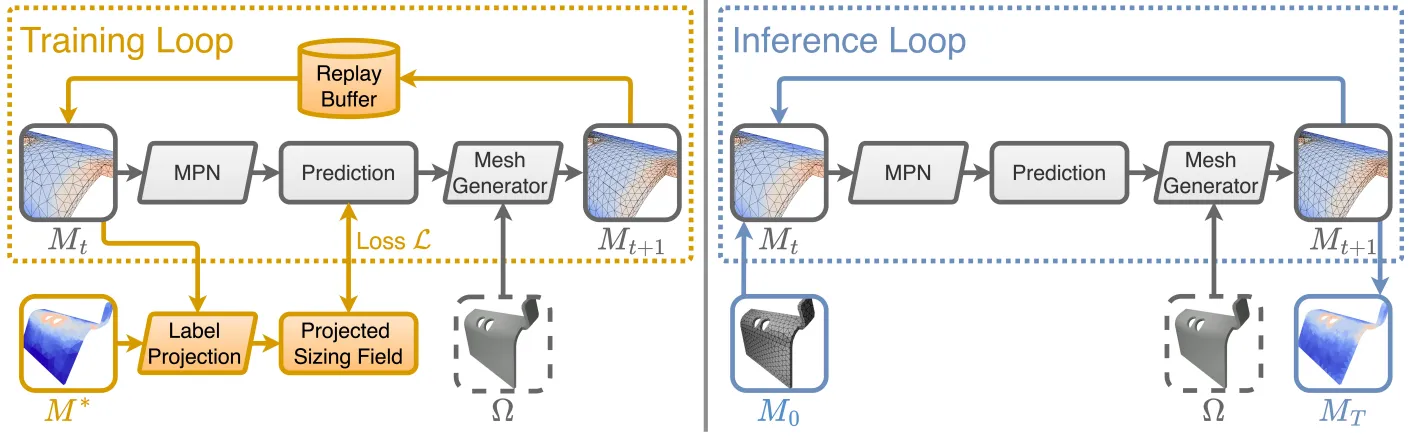
Physical systems are encoded as graphs on which message passing networks learn the dynamics. GGNS grounds predictions with point-cloud observations, ROBIN captures global deformation modes of nonlinear solids (NeurIPS 2025 spotlight), and hierarchical graph networks were applied to forming of thermoplastic composites. ASMR and AMBER adapt the mesh resolution, while M3GN and MaNGO predict whole trajectories to avoid compounding errors.
 Enlarge figure
 Overview of the training (left) and inference (right) of AMBER, which learns adaptive mesh generation on complex geometries from an expert dataset. Figure: Freymuth et al., NeurIPS 2025. Publications
-
Grounding Graph Network Simulators using Physical Sensor Observations
ICLR, 2023
-
Diffusion-Based Hierarchical Graph Neural Networks for Simulating Nonlinear Solid Mechanics
NeurIPS, 2025
-
Key Engineering Materials, 2026
-
Swarm Reinforcement Learning for Adaptive Mesh Refinement
NeurIPS, 2023
-
Adaptive Swarm Mesh Refinement using Deep Reinforcement Learning with Local Rewards
Machine Learning, 2026
-
AMBER: Adaptive Mesh Generation by Iterative Mesh Resolution Prediction
NeurIPS, 2025
-
Context-aware Learned Mesh-based Simulation via Trajectory-Level Meta-Learning
Transactions on Machine Learning Research, 2026
-
MaNGO – Adaptable Graph Network Simulators via Meta-Learning
NeurIPS, 2025
-
-
M2.2 Action and parameter-conditioned dynamics models
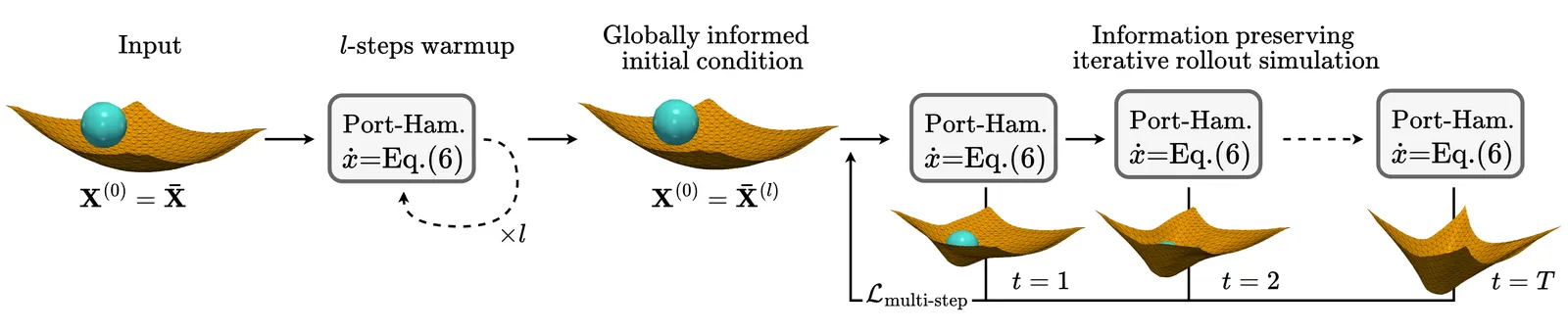
In stamp forming, the effect of a globally applied force must reach every node of the mesh at the first step, far beyond the receptive field of a shallow graph network simulator. IGNS structures message passing as port-Hamiltonian dynamics that preserve energy and momentum, keeping long rollouts physically consistent (ICLR 2026). HEPi represents grippers and a deformable sheet as a heterogeneous graph with SE(3)-equivariant message passing, the architectural basis for action-conditioned models (ICLR 2025, oral). STORM carries oscillatory message passing over to space and time, so information propagates over long ranges in spatio-temporal graphs (NeurIPS 2026).
 Enlarge figure
 IGNS. Port-Hamiltonian warm-up steps give a globally informed initial condition, followed by an information-preserving iterative rollout, trained with a multi-step loss. Figure: Hoang et al., ICLR 2026. Publications
-
Improving Long-Range Interactions in Graph Neural Simulators via Hamiltonian Dynamics
ICLR, 2026
-
Long-Range Spatio-Temporal Graph Propagation Through Oscillations
NeurIPS, 2026
-
Geometry-aware RL for Manipulation of Varying Shapes and Deformable Objects
ICLR, 2025
-
-
M2.3 Adaptation to real-world data and transfer learning
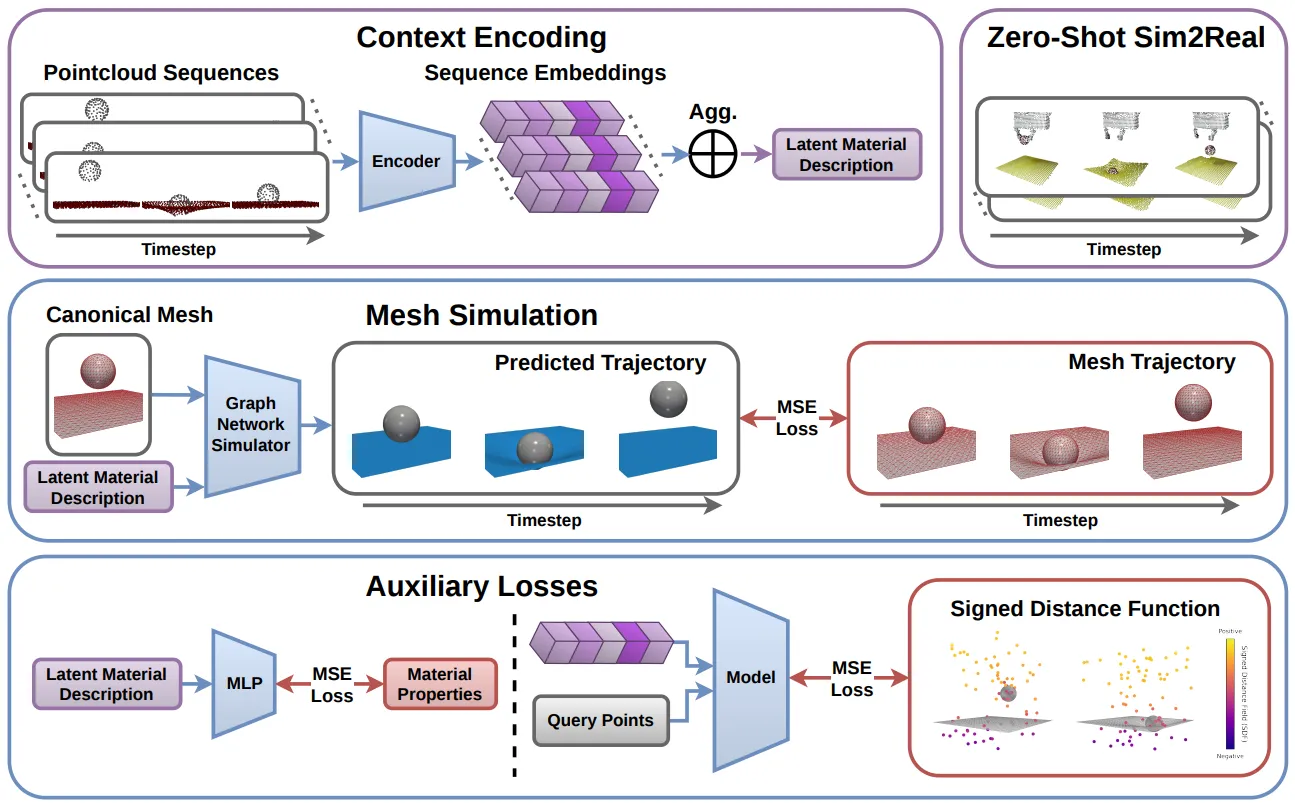
MaNGO frames simulation as in-context learning, so a handful of trajectories of a new material condition the simulator without any gradient update (NeurIPS 2025). PEACH encodes point-cloud sequences instead of meshes. Trained only on simulated point clouds and evaluated on real observations, it adapts to unseen materials from a small context set (NeurIPS 2026).
 Enlarge figure
 Overview of the PEACH framework. It encodes point-cloud sequences into a latent material representation that conditions a mesh-based simulator, and generalises to unseen materials and real-world data. Figure: Dahlinger et al., NeurIPS 2026. Publications
-
MaNGO – Adaptable Graph Network Simulators via Meta-Learning
NeurIPS, 2025
-
Context-aware Learned Mesh-based Simulation via Trajectory-Level Meta-Learning
Transactions on Machine Learning Research, 2026
-
Point Cloud Sequence Encoding for Material-conditioned Graph Network Simulators
NeurIPS, 2026
-
-
M2.4 Simulation and physics-informed models
PI-MGN combines message passing with a finite element residual loss that enforces the governing equations during training, and generalises to non-stationary and nonlinear problems on arbitrary meshes. The hierarchical architectures of AMBER and ROBIN are precursors for learning residual corrections to coarse classical solvers, and ongoing work uses learned models as initial guesses for Newton solvers.
Publications
-
Computer Methods in Applied Mechanics and Engineering, 2024
-
About the subproject
Our models predict the geometry and the spatially distributed state of the part. Physical knowledge keeps them accurate when data are scarce, and point-cloud observations connect them to real objects.
- Principal investigators
- Researchers
-
- Philipp Dahlinger
- Tai Hoang
- Tobias Würth
- Former members
-
- Dr. Niklas Freymuth
- Host institute
- Autonomous Learning Robots (ALR), KIT
Publications 16
-
Adaptive Swarm Mesh Refinement using Deep Reinforcement Learning with Local Rewards
-
Context-aware Learned Mesh-based Simulation via Trajectory-Level Meta-Learning
-
Improving Long-Range Interactions in Graph Neural Simulators via Hamiltonian Dynamics
-
Long-Range Spatio-Temporal Graph Propagation Through Oscillations
-
Point Cloud Sequence Encoding for Material-conditioned Graph Network Simulators
-
Smooth Sampling-Based Model Predictive Control Using Deterministic Samples
-
AMBER: Adaptive Mesh Generation by Iterative Mesh Resolution Prediction
-
Diffusion-Based Hierarchical Graph Neural Networks for Simulating Nonlinear Solid Mechanics
-
Geometry-aware RL for Manipulation of Varying Shapes and Deformable Objects
-
MaNGO – Adaptable Graph Network Simulators via Meta-Learning
-
Grounding Graph Network Simulators using Physical Sensor Observations