



M3 Optimise
State- and Parameter-Space Exploration and Process Optimisation
M3 finds good process settings with as few trials as possible, using what can be observed between process stages.
Work packages
Results of the first funding phase, by work package.
-
M3.1 Simulated benchmark environment for multi-stage exploration and optimisation
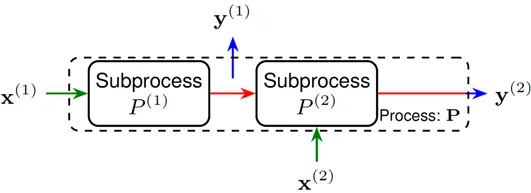
A simulation package for multi-stage systems defines subprocesses with their inputs, outputs and noise, and connects them into a directed acyclic graph. It works with scalable Bayesian optimisation packages such as BoTorch and with GPU-accelerated inference.
 Enlarge figure
 A multi-stage process as a chain of subprocesses, each with its own inputs and observable outputs. Figure: KI-FOR 5339. -
M3.2 Multi-stage Bayesian optimisation
A non-isothermal glass moulding process served as a real multi-stage test dataset, with a new validation strategy that combines stratified sampling and bootstrapping. Joint parameter and state-space (JPSS) modelling extracts latent features from intermediate time series and consistently outperformed direct input-output models. It received the Best Student Paper Award in the AI for Industry track at IEEE INDIN 2024.
-
M3.3 Open-loop trajectory exploration and optimisation
The Partially Observable Gaussian Process Network (POGPN) treats the output of each node as latent and only partially observed. This propagates uncertainty correctly across the whole process network and models noisy intermediate observations. The model is trained with variational inference and runs with BoTorch.
Publications
-
Bayesian Optimization using Partially Observable Gaussian Process Network
NeurIPS Workshop on Machine Learning and Operations Research, 2025
-
-
M3.4 Robust multi-stage exploration and optimisation
A trust-region method based on Fisher information works with any model that has a smooth, differentiable posterior, together with a theoretical analysis of vanishing gradients in high-dimensional Bayesian optimisation (NeurIPS 2026).
Publications
-
M3.5 Joint state-space and parameter-space exploration and optimisation
POGPN outperformed conventional Gaussian process networks and Bayesian optimisation on high-dimensional benchmark functions and a penicillin production simulation, with noise-free and noisy observations. Combined with JPSS, it was tested on high-dimensional time series of a multi-stage bioethanol process.
Publications
-
Bayesian Optimization using Partially Observable Gaussian Process Network
NeurIPS Workshop on Machine Learning and Operations Research, 2025
-
CIRP CMS, 2026
-
Joint parameter and state-space modelling of manufacturing processes using Gaussian processes
INDIN, 2024
-
-
M3.6 Application to the physical composite stamp-forming process
Bayesian optimisation of gripper positions and forces, run on a high-fidelity Abaqus forming simulation, reduced out-of-plane wrinkling of carbon-fibre thermoplastic laminates, and trust-region methods also placed an additional gripper. A sensitivity analysis showed that the gripper positions matter more than the gripper forces.
Publications
-
Composites Part A: Applied Science and Manufacturing, 2026
-
A result, jointly with M1, T1 and T2
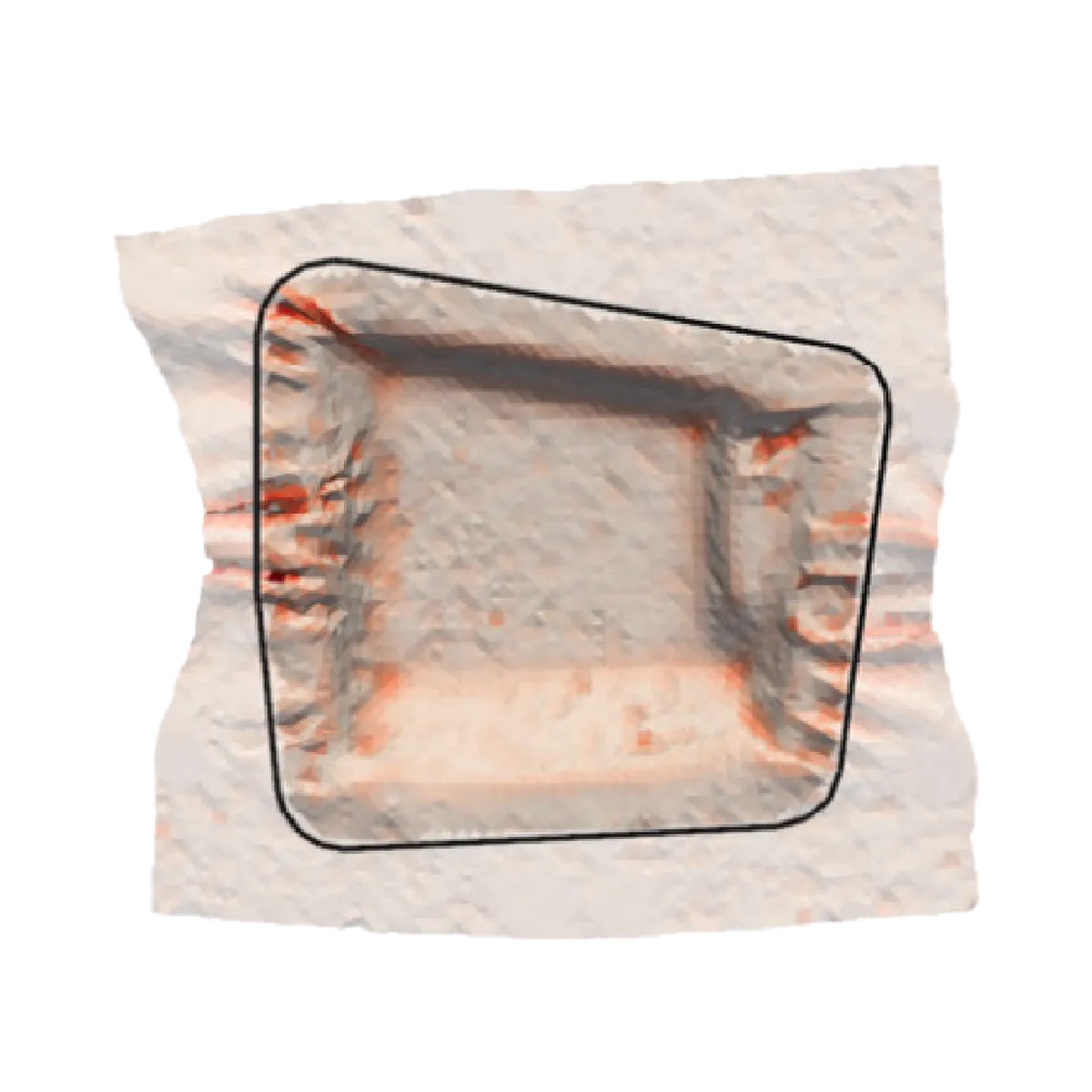
Random gripper layout
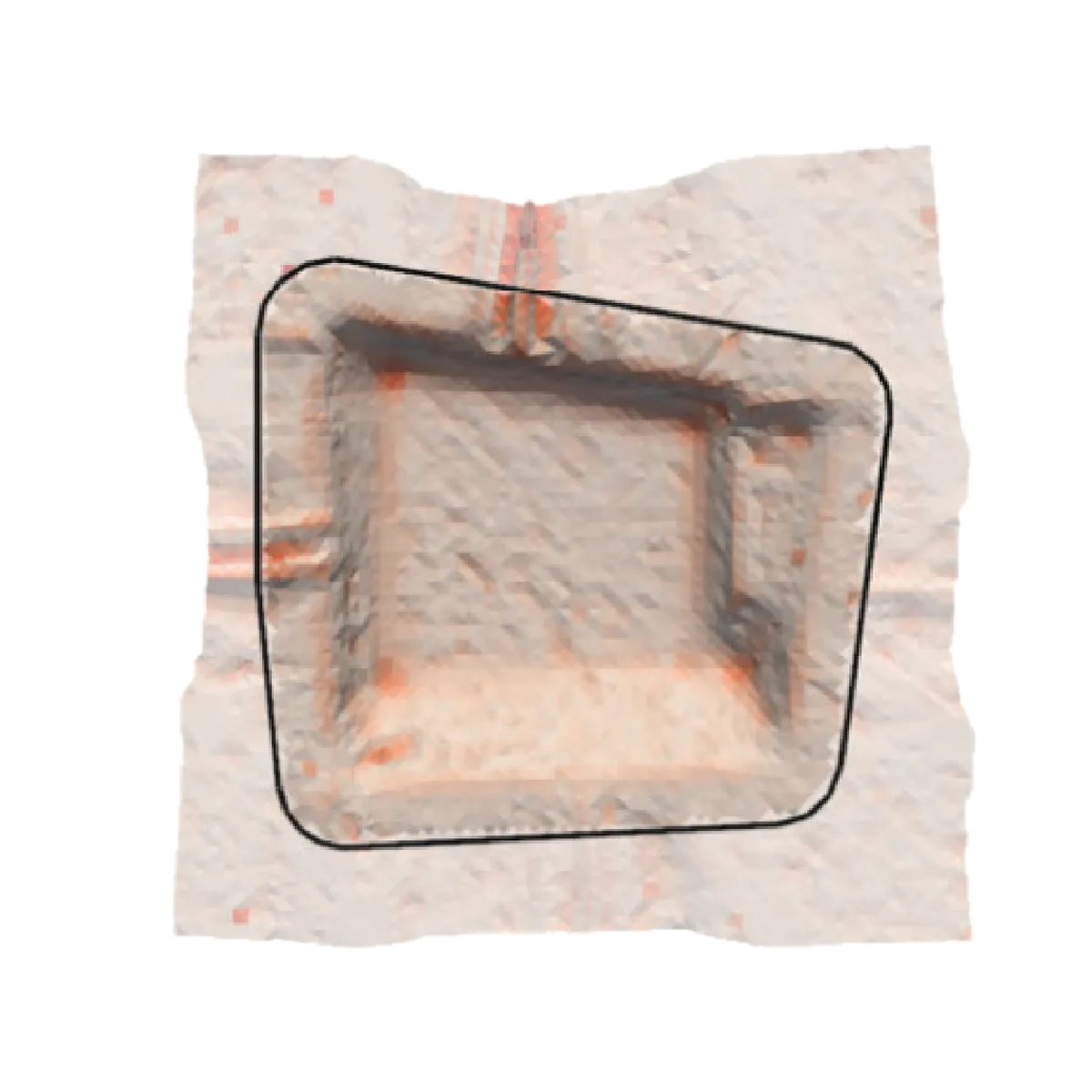
Layout found by Bayesian optimisation
About the subproject
Every real trial is expensive, so each one should teach us as much as possible. Bayesian optimisation weighs what the model already knows against where it is still uncertain, and proposes the next trial accordingly.
- Principal investigators
- Researchers
-
- Saksham Kiroriwal
- Host institute
- Fraunhofer IOSB
Publications 7
-
Bayesian Optimization with Fisher Information Geometry: Gradient Bounds and Trust-Region Methods
-
BOING: Optimizing Bayesian Optimization with Information Geometry
-
Bayesian Optimization using Partially Observable Gaussian Process Network
-
Joint parameter and state-space modelling of manufacturing processes using Gaussian processes