



F Measure
Management and Quantification of Maturity Improvement
F defines measures of process maturity and records the demonstrator's data and their provenance in a knowledge graph.
Work packages
Results of the first funding phase, by work package.
-
F.1 Formal process maturity measure
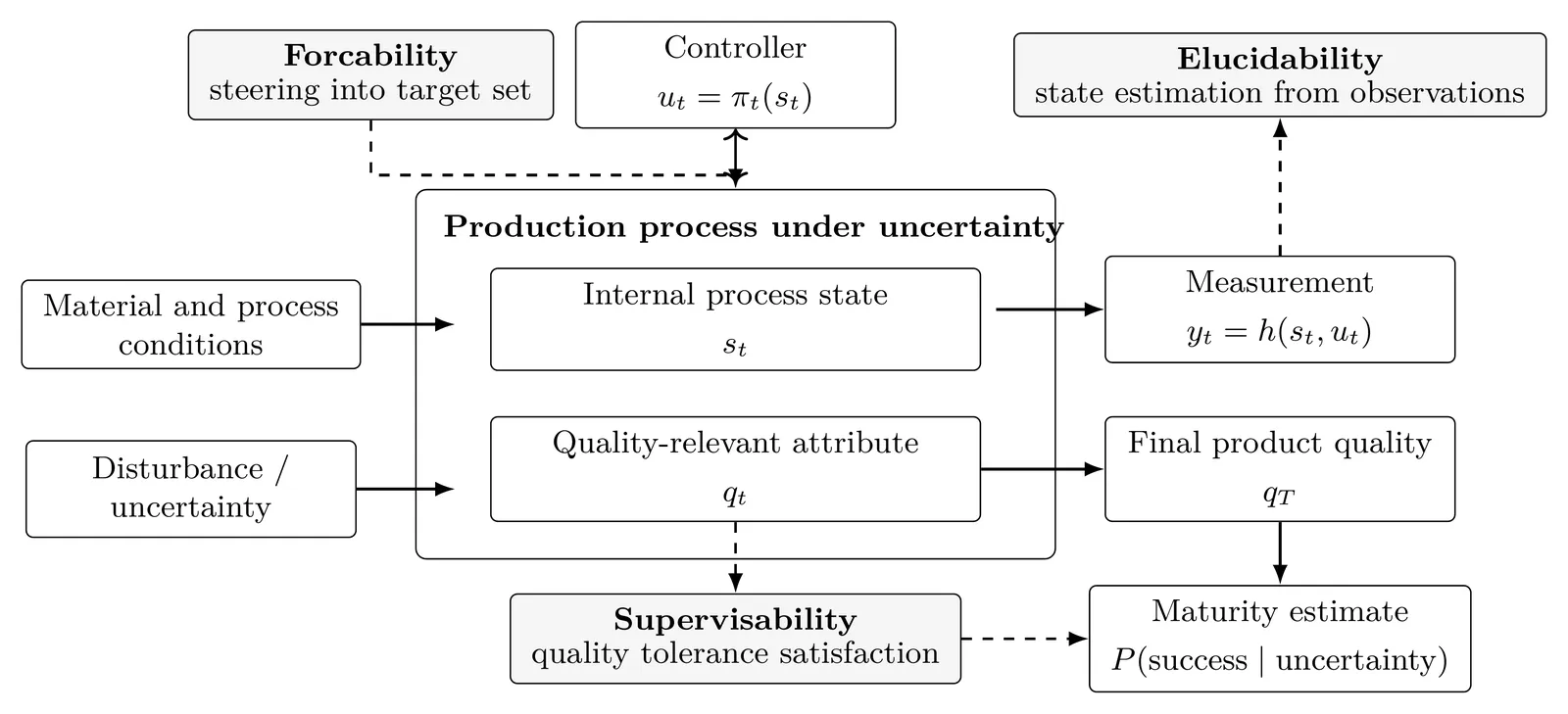
Elucidability, Forcability and Supervisability translate observability, controllability and quality tolerance into probabilistic maturity measures. Forcability was made computable as a stochastic reach-avoid problem, solved with approximate dynamic programming and estimated by Monte Carlo simulation on an electric arc furnace example. Supervisability and Elucidability exist so far in simplified form.
 Enlarge figure
 The three maturity measures around a production process under uncertainty. Forcability concerns steering into a target set, Elucidability state estimation from observations, and Supervisability the satisfaction of quality tolerances. Figure: KI-FOR 5339. Publications
-
How to Quantify the Maturity of Production Processes
ML4CPS, 2025
-
-
F.2 Virtual Process Dossier (VPD)
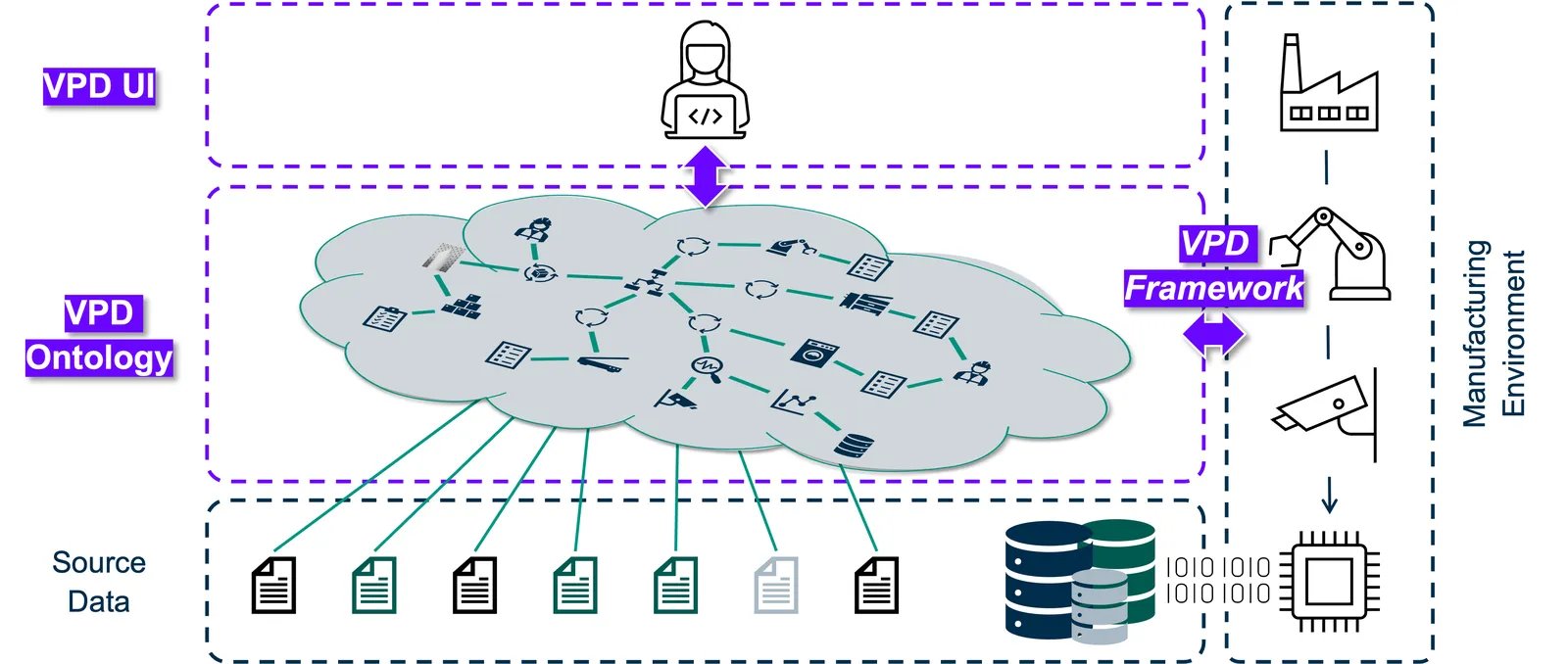
The VPD is a process-aware data catalogue that adds a knowledge-graph layer above the raw data and captures prospective and retrospective workflow provenance, with a schema that reuses DCAT, PROV, SOSA/SSN, QUDT and WiLD. A provenance-capturing framework and a web interface were implemented, and the example process was modelled in the VPD. The publication is under review.
 Enlarge figure
 High-level overview of the knowledge-graph-based FAIR research data infrastructure. Figure: KI-FOR 5339. Publications
-
F.3 Hybrid semantic-qualitative-numerical question answering
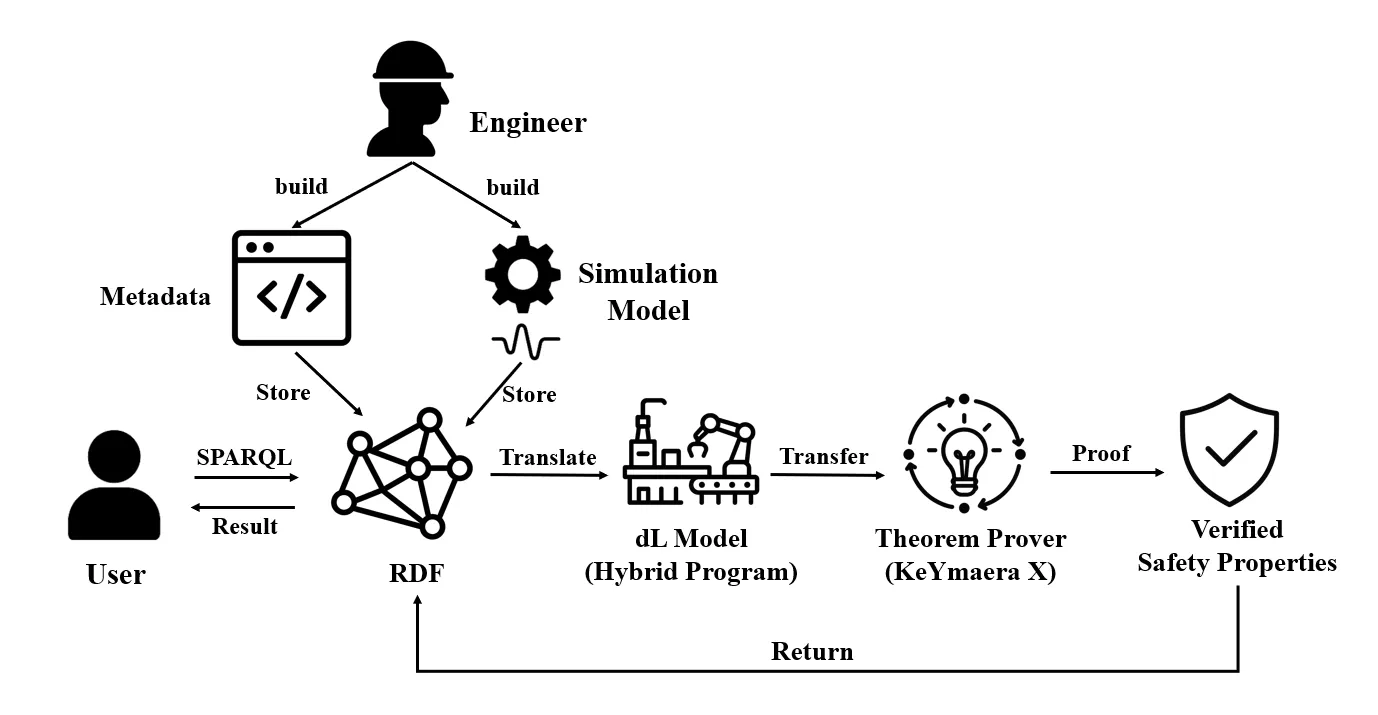
RDFdL integrates RDF with differential dynamic logic, verifies transitions with KeYmaera X and returns the verified results as queryable RDF. Graph-based retrieval-augmented generation was evaluated on airport data, a shape-based SPARQL generator placed among the top three in several sub-challenges of the Text2SPARQL challenge at ESWC 2025, and a bounded LLM decision layer improved a fixed baseline in 200 simulated scenarios of a composite-forming workflow (CASE 2026).
 Enlarge figure
 RDFdL system overview. Figure: KI-FOR 5339. Publications
-
Evaluating the Performance of RAG Methods for Conversational AI in the Airport Domain
NAACL, 2025
-
ESWC, 2025
-
LLM-Based Pre-Press Decision Support for an Industrial Composite-Forming Workflow
CASE, 2026
-
About the subproject
F spans all subprojects. It defines when a process counts as mature, and its Virtual Process Dossier records experiments, simulations and decisions with their provenance.
- Principal investigators
- Researchers
-
- Lukas Kubelka
- Yuyang Li
- Zahra Nasrollah
- Former members
-
- Negar Arabizadeh
- Host institute
- Vision and Fusion Laboratory (IES), KIT
Publications 8
-
LLM-Based Pre-Press Decision Support for an Industrial Composite-Forming Workflow
-
Evaluating the Performance of RAG Methods for Conversational AI in the Airport Domain
-
Towards Using the Solid Protocol for Data Transport in International Data Spaces (IDS)
-
Workshop Report: Learning Approaches for Hybrid Dynamical Systems
-
Towards Representing Processes and Reasoning with Process Descriptions on the Web