



Demanding materials
Fibre-reinforced thermoplastics are stiff along the fibres and soft across them. Stacked in layers, they deform in ways that depend on temperature and speed.
Every trial on a new manufacturing process is expensive. We develop AI methods that learn more from each trial, and a methodology that takes a process from immature to mature with fewer of them.
A new process first runs in the lab, then ramps up to industrial scale. Only then does it deliver the required quality, output and cost. This takes long when new materials are involved, when the process has many settings, and when no good model of it exists.
Maturing such a process means choosing its structure, its settings, its control and its sensors. Experts do this by experiment, guided by experience. Each experiment ties up equipment, uses material and may require destructive testing of the part.
We expect AI to speed up maturation and to find better solutions. Few, expensive and noisy samples also demand new methods in AI itself.
Fibre-reinforced thermoplastics are stiff along the fibres and soft across them. Stacked in layers, they deform in ways that depend on temperature and speed.
Temperatures, speeds, forces and gripper positions interact, and tuning the conventional settings alone does not prevent wrinkles.
Defects such as wrinkles show up only after forming. Every trial costs machine time and material, and some parts must be destroyed to test them.
A new material or geometry usually means repeating the experiments. What was learned on one variant rarely carries over to the next.
We combine data-driven learning, optimisation and reinforcement learning with physical knowledge and engineering models, and we plan each experiment so that it teaches us as much as possible.
Temporary over-instrumentation, a modular process and step-by-step improvement turn an immature process into a mature one, with tools that scale to large teams.
Across all stages
F Maturity and knowledge Maturity measures and a knowledge graph of the process dataProcess chain
Data acquisition
Learned simulation
Optimisation and control
The participating institutes built the example process in the Karlsruhe Research Factory: non-isothermal stamp forming of thermoplastic composite sheets, an immature process with a high potential for improvement. The stamp-forming laboratory of Fraunhofer ICT is used for further experiments.
A sledge on a linear axis picks up the laminate in a gripper frame. The grippers measure force, position and angle.
An infrared oven melts the thermoplastic matrix.
A press with two heatable tools forms the hot laminate, which solidifies as it cools.
A robot takes images and 3D scans of the part. The data are stored, and their metadata are catalogued in the Virtual Process Dossier.
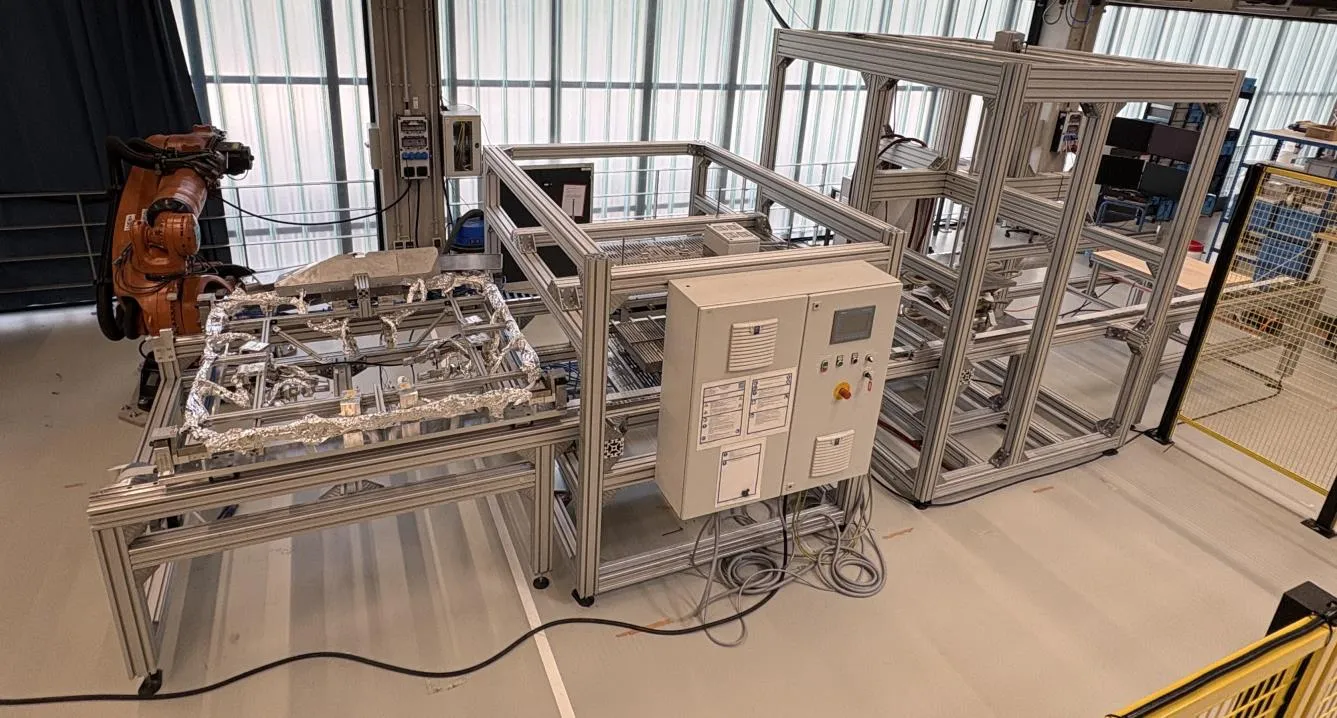
The tapes are strongly anisotropic. They deform with large strains, depend on temperature and forming speed, slide against each other, and shrink as they solidify. The press forms the parts only partly, which is enough to study quality precursors, in particular wrinkle formation.
In the published forming experiments on industrial-scale equipment, the laminates were unidirectional carbon-fibre tapes in a polyamide 6 matrix, for example twelve plies in a (0/90/45/−45/0/90)s sequence. Such tapes promise light parts that can be formed automatically in short cycle times and recycled (Zeeb et al. 2025).
In the first funding phase we developed the core components of the methodology and validated each of them on its own: in forming experiments, forming simulations, benchmarks and external process datasets.
Material characterisation parameterised the physics-based forming simulations, and temperature measurements from forming experiments were used to validate them. The simulations then supplied data for learning and for testing gripper configurations that were never built.
A learned simulator predicts stamp forming of thermoplastic laminates for unseen process settings in seconds instead of hours.
Bayesian optimisation used the validated simulation to find gripper layouts that reduce wrinkling.
M4 developed particle-flow filters, calibrated sensor models, sampling-based model predictive control and, with M2, geometry-aware reinforcement learning for distributed actuators. Each was validated on simulation benchmarks.
The Virtual Process Dossier, a knowledge-graph data catalogue, records the demonstrator's experiments, simulations and their provenance and can be queried via SPARQL.
Process data are expensive to produce, so we keep them findable and reusable, following the FAIR principles. The Virtual Process Dossier describes machines, materials, settings, processes and parts with shared vocabularies and records who produced which data, when and how.
We publish data where we can, for example the process simulation data for thermoforming on Zenodo. Large simulation campaigns and model training run on the HoreKa supercomputer at KIT.