



M1 Sense
Systematic Over-Instrumentation
M1 decides which sensors and actuators to add while a process is immature, and which to remove once it matures.
Work packages
Results of the first funding phase, by work package.
-
M1.1 Optimal sensor and actuator placement and parameterisation
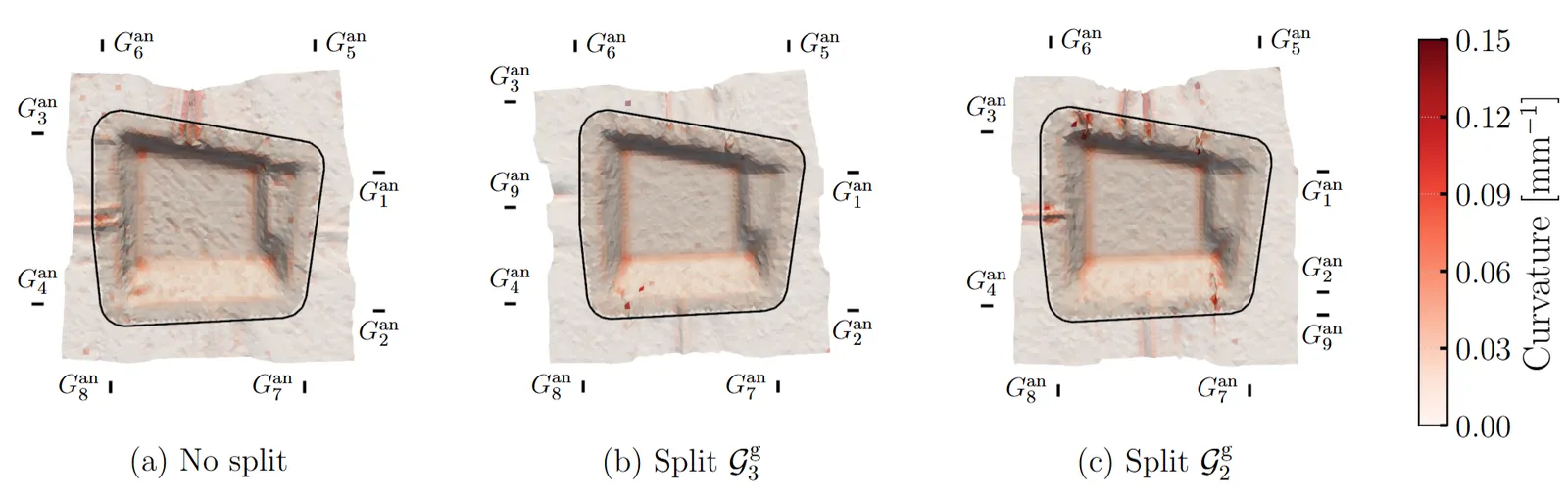
Bayesian optimisation, developed with M3, identifies gripper configurations that improve product quality in a high-fidelity forming simulation from T2, and places an additional gripper in a targeted way. A second method places additional or mobile sensors for fault diagnosis under model mismatch. Validation on the real system is planned.
 Enlarge figure
 Simulated forming results, with curvature in colour. (a) Configuration of eight grippers optimised by Bayesian optimisation. (b) Improved result with an additional, locally optimised gripper. (c) A less effective placement of the additional gripper. Figure: After Döhner et al. 2026. Publications
-
Composites Part A: Applied Science and Manufacturing, 2026
-
-
M1.2 Discovery of latent variables
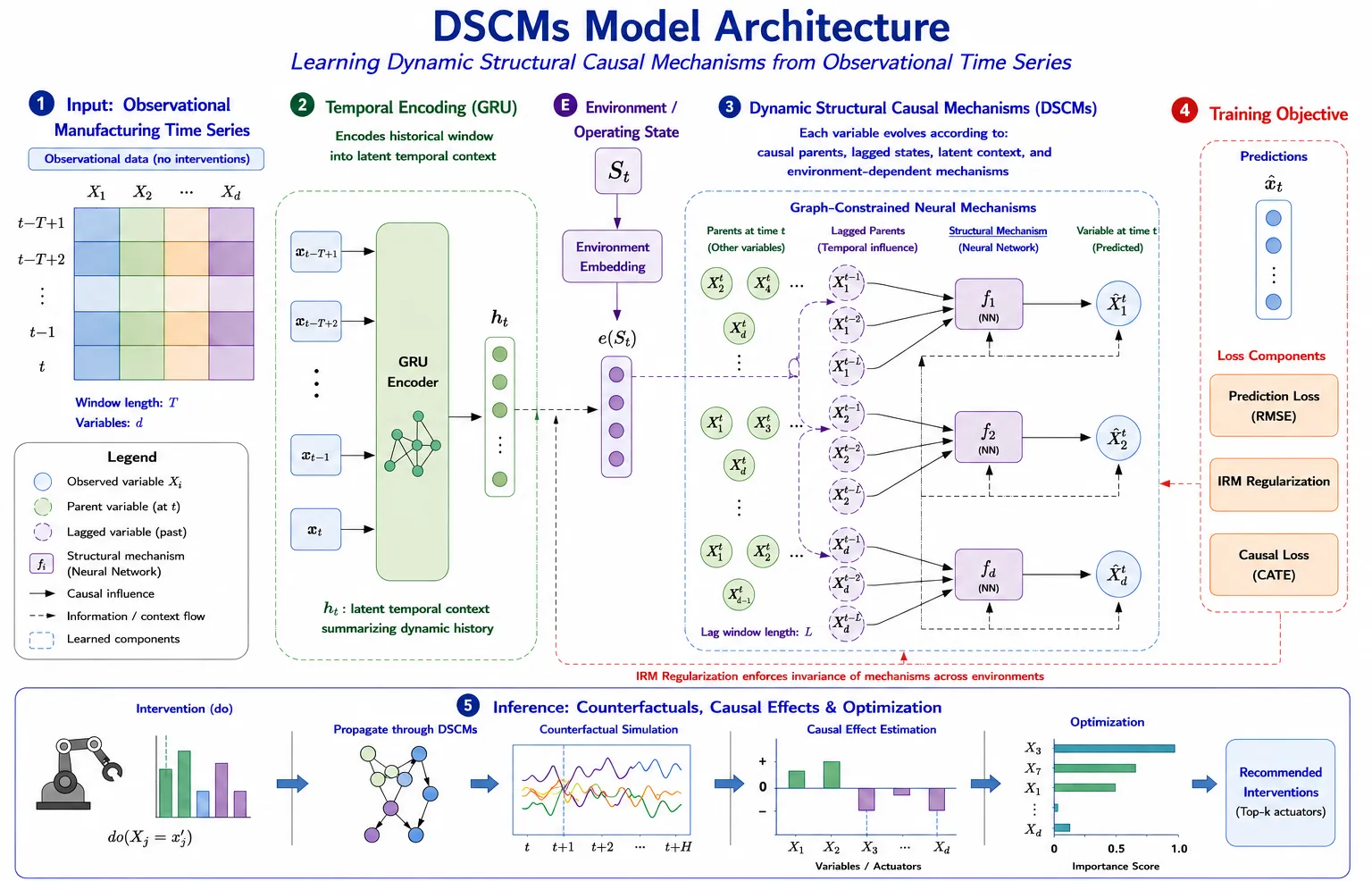
Causal root-cause analysis combines anomaly detection with expert-defined causal graphs and process-step information, and a counterfactual extension explains why one root cause is more likely than another. Further methods learn causal structure from wavelet-based soft interventions, evaluate learned causal graphs with a normalised causal edit distance, and learn dynamic structural causal mechanisms from time series.
 Enlarge figure
 Overview of the dynamic structural causal mechanisms (DSCM) method. Observational time series are encoded by a GRU and environment embeddings, then combined with graph-constrained neural mechanisms to learn dynamic causal relationships. Figure: KI-FOR 5339. Publications
-
Root Cause Analysis Using Anomaly Detection and Temporal Informed Causal Graphs
ML4CPS, 2024
-
Counterfactual Root Cause Analysis via Anomaly Detection and Causal Graphs
INDIN, 2023
-
Causal Structure Learning Using PCMCI+ and Path Constraints from Wavelet-Based Soft Interventions
ML4CPS, 2023
-
Metrics for the Evaluation of Learned Causal Graphs Based on Ground Truth
ML4CPS, 2024
-
-
M1.3 Sensitivity and influence analysis
A method combines causal discovery, causal inference and temporal neural networks. It selects the variables with a causal influence on the outcome and estimates their effect through the conditional average treatment effect, as a basis for a minimal relevant sensor set.
Publications
-
M1.4 Application and validation
Patterns printed on the laminate before forming make defects such as folds visible afterwards, and methods for automated fold detection are being developed. Transferring the Bayesian optimisation of the gripper configuration to the real forming process is planned, and the influence of low-frequency tool vibrations on forming is being measured on a dedicated test rig.
About the subproject
Early on, generous instrumentation is the fastest way to understand a new process. Later, many sensors are no longer needed, and the process should run with fewer and cheaper ones.
- Principal investigators
- Researchers
-
- Hannah Decker
- Frank Döhner
- Zahra Nasrollah
- Shahenda Youssef
- Georg Zeeb
- Former members
-
- Dr. Josephine Rehak
- Host institute
- Institute of Vehicle System Technology (FAST), KIT
Publications 9
-
Adaptive Sequential Sensor Placement for Robust and Efficient Online Fault Diagnosis
-
Causal Temporal Neural Networks Using the Conditional Average Treatment Effect
-
Metrics for the Evaluation of Learned Causal Graphs Based on Ground Truth
-
Root Cause Analysis Using Anomaly Detection and Temporal Informed Causal Graphs
-
Causal Structure Learning Using PCMCI+ and Path Constraints from Wavelet-Based Soft Interventions
-
Counterfactual Root Cause Analysis via Anomaly Detection and Causal Graphs