



M4 Control
Efficient and Accurate State Estimation and Feedback Control under Uncertainties
M4 estimates the hidden state of the running process and steers it, although it is observed only partly and with noise.
Work packages
Results of the first funding phase, by work package.
-
M4.1 Stochastic filtering in large, distributed state spaces
A Newton-flow particle filter formulates the particle update as an ordinary differential equation derived from a generalised Cramér–von Mises distance. The particles keep equal weights, which avoids degeneracy and global resampling, and deterministic Dirac-mixture samples reduce the number of particles needed.
Publications
-
M4.2 Accurate sensor models for state estimation
Bayesian neural networks trained with variational inference, Hamiltonian Monte Carlo and Kalman-filter backends serve as uncertainty-aware sensor models. Local calibration tests based on k-d trees, ball trees, Voronoi regions and kernels reveal where such models are miscalibrated, and new multivariate metrics assess calibration across all outputs.
Publications
-
FUSION, 2025
-
Trustworthy Bayesian Perceptrons
FUSION, 2024
-
Multi-Scale Uncertainty Calibration Testing for Bayesian Neural Networks Using Ball Trees
MFI, 2024
-
Voronoi Trust Regions for Local Calibration Testing in Supervised Machine Learning Models
SDF, 2024
-
Local Calibration Testing in Supervised Machine Learning Models Using Input Space Kernels
FUSION, 2025
-
Local Modified Cramér–von Mises Distance for Uncertainty Calibration Assessment in Regression
FUSION, 2026
-
Weaknesses of the ANEES and New Calibration Measures for Multivariate Predictions
MFI, 2025
-
-
M4.3 Stochastic feedback control of nonlinear distributed processes
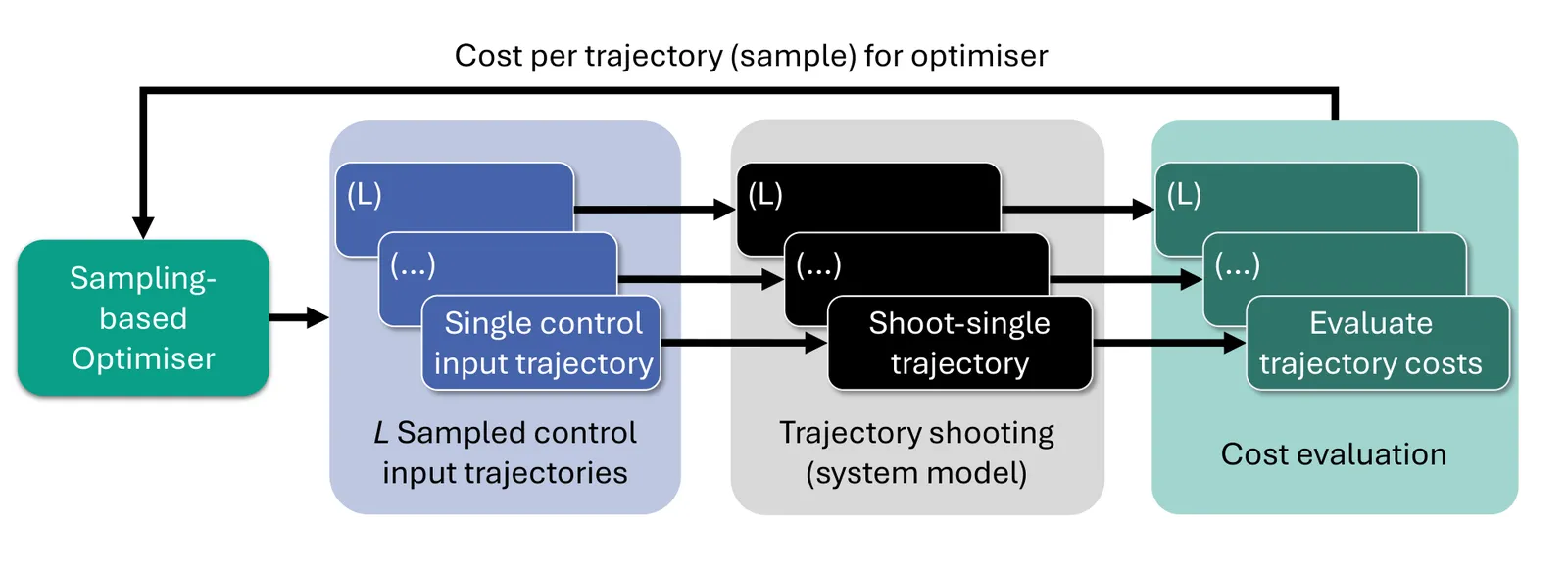
Gradient-free, sampling-based model predictive control, built on the cross-entropy method and model predictive path integral control, handles non-differentiable simulators such as Abaqus. Precomputed deterministic samples cover the solution space with fewer samples and give smoother control inputs. The methods were validated on benchmarks and forming simulations.
 Enlarge figure
 Sampling-based model predictive control allows gradient-free optimisation of control inputs. Sampled control trajectories are used to predict the behaviour of the system (trajectory shooting), which can be parallelised efficiently. Figure: KI-FOR 5339. Publications
-
M4.4 Model-based policy optimisation of nonlinear distributed controllers
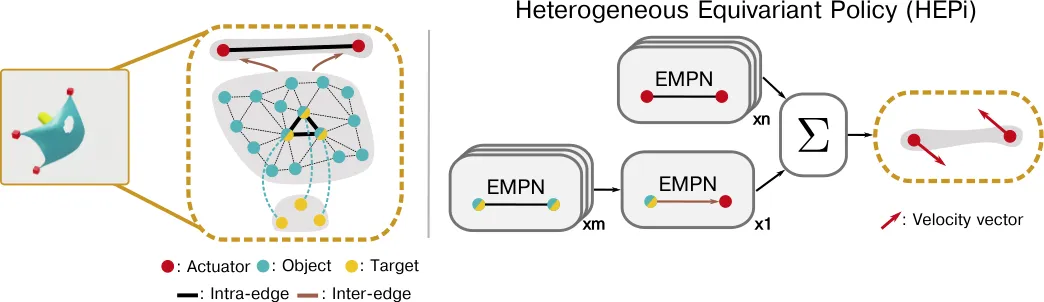
HEPi, the main contribution on the policy-learning side, optimises structure-aware distributed controllers in simulation with a heterogeneous graph and SE(3)-equivariant message passing, improving sample efficiency, final performance and generalisation across object geometries. IGNS adds structure-preserving learned simulators as a basis for future action-conditioned planning and control.
 Enlarge figure
 Overview of the Heterogeneous Equivariant Policy (HEPi). Equivariant message passing networks process the observation graph and aggregate the actuator, object and target nodes into the action. Figure: Hoang et al., ICLR 2025.
About the subproject
M4 is designed to build on the learned models of M2 and the settings found by M3, and to keep the process on track while it runs, where M3 improves it from trial to trial. Because the forming hardware allows only feedforward actuation, its methods were validated on benchmarks and in simulation.
- Principal investigators
- Researchers
-
- Tai Hoang
- Xiaozhu Luo
- Markus Walker
- Host institute
- Intelligent Sensor-Actuator-Systems Laboratory (ISAS), KIT
Publications 14
-
Gaussian Homotopy Optimization with Predictor–Corrector Path Tracking and Deterministic Sampling
-
Improving Long-Range Interactions in Graph Neural Simulators via Hamiltonian Dynamics
-
Local Modified Cramér–von Mises Distance for Uncertainty Calibration Assessment in Regression
-
Smooth Sampling-Based Model Predictive Control Using Deterministic Samples
-
Geometry-aware RL for Manipulation of Varying Shapes and Deformable Objects
-
Local Calibration Testing in Supervised Machine Learning Models Using Input Space Kernels
-
Weaknesses of the ANEES and New Calibration Measures for Multivariate Predictions
-
Newton-Flow Particle Filters based on Generalized Cramér Distance
-
Multi-Scale Uncertainty Calibration Testing for Bayesian Neural Networks Using Ball Trees
-
Voronoi Trust Regions for Local Calibration Testing in Supervised Machine Learning Models
-
Progressive Bayesian Particle Flows Based on Optimal Transport Map Sequences