



Demanding materials
Fibre-reinforced thermoplastics are stiff along the fibres and soft across them. Stacked in layers, they deform in ways that depend on temperature and speed.
DFG Research Unit KI-FOR 5339
Thermoplastic composites promise light parts that can be formed automatically in short cycles and recycled. But a new material or part design can make a known process immature again, and costly trial and error follows. We develop AI that learns from every trial and reuses what it has learned, so that new processes mature with fewer trials.
Karlsruhe Institute of Technology and Fraunhofer IOSB
Funded by the Deutsche Forschungsgemeinschaft since 2023
Four things make new processes slow to mature. Today, experts close the gap with extensive experiments, guided by experience.
Fibre-reinforced thermoplastics are stiff along the fibres and soft across them. Stacked in layers, they deform in ways that depend on temperature and speed.
Temperatures, speeds, forces and gripper positions interact, and tuning the conventional settings alone does not prevent wrinkles.
Defects such as wrinkles show up only after forming. Every trial costs machine time and material, and some parts must be destroyed to test them.
A new material or geometry usually means repeating the experiments. What was learned on one variant rarely carries over to the next.
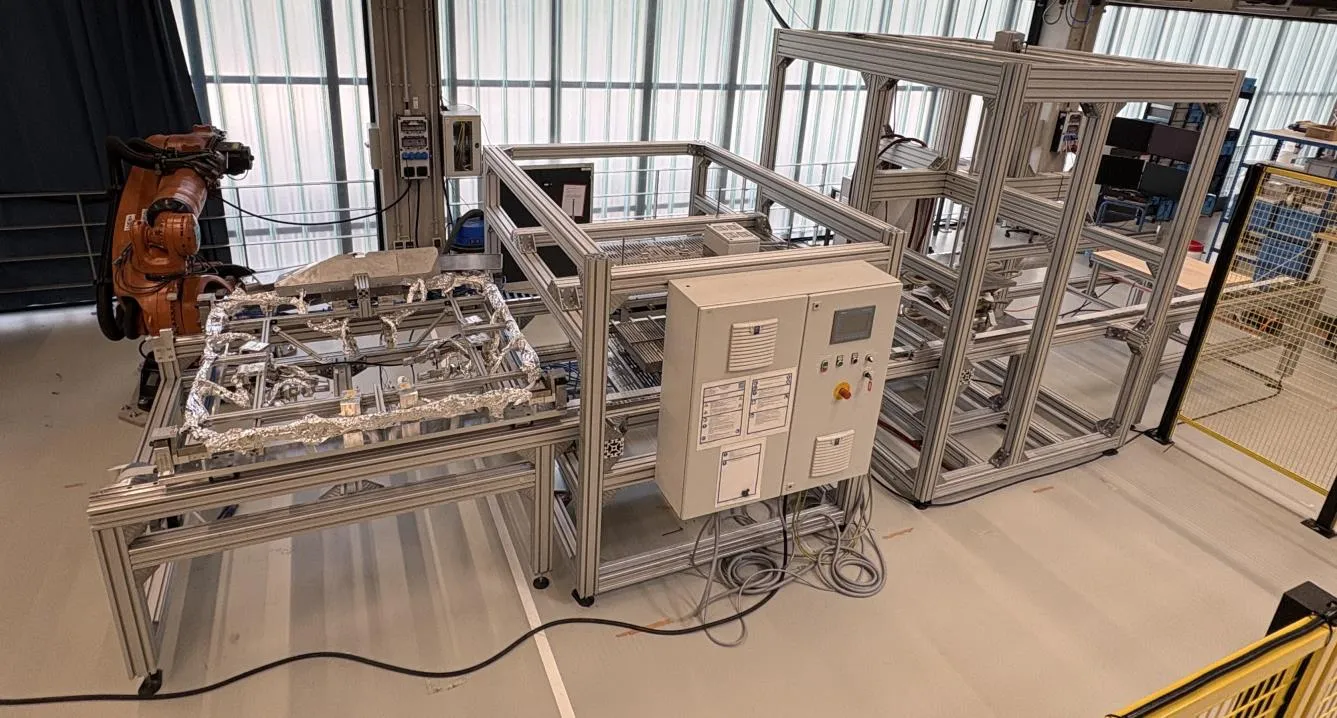
The demonstrator in T1 provides the process and its experiments. T2 simulates it, and M1 decides which sensors observe it. M2 learns fast process models, mainly from T2's simulation data. M3 optimises the process settings, and M4 estimates the process state and controls it. F defines measures of maturity and records the process data in a knowledge graph.
Across all stages
F Maturity and knowledge Maturity measures and a knowledge graph of the process dataProcess chain
Data acquisition
Learned simulation
Optimisation and control
Point at a subproject to see its idea in motion, or open it for the details.
T1 Build
T1 builds the physical process from modular blocks, so it can be changed and instrumented quickly, and develops a digital twin of it.
T2 Simulate
T2 builds validated simulations of the process that supply data sensors cannot measure and test changes before they are built.
M1 Sense
M1 decides which sensors and actuators to add while a process is immature, and which to remove once it matures.
M2 Learn
M2 learns fast simulators of the forming process from simulation and sensor data, and adapts them to new material properties from a few examples.
M3 Optimise
M3 finds good process settings with as few trials as possible, using what can be observed between process stages.
M4 Control
M4 estimates the hidden state of the running process and steers it, although it is observed only partly and with noise.
F Measure
F defines measures of process maturity and records the demonstrator's data and their provenance in a knowledge graph.
C Coordinate
C coordinates the Research Unit, organises joint events and supports early-career researchers.
The Research Unit studies its methods on non-isothermal stamp forming of thermoplastic tape laminates, an immature process with a high potential for improvement. It runs on a demonstrator in the Karlsruhe Research Factory and in the stamp-forming laboratory of Fraunhofer ICT.
The published forming experiments used unidirectional carbon-fibre tapes in a polyamide 6 matrix, stacked into laminates with different fibre directions (Zeeb et al. 2025).
An infrared oven melts the matrix. The press then forms the hot laminate, which solidifies as it cools in the tool. Wrinkles are the main defect we study.
Ten of our 62 publications, chosen to cover every subproject. Members of the Research Unit are shown in dark type.
Composites Part A 2026
Composites Part A 2026
CMAME 2024
NeurIPS 2025 Spotlight
NeurIPS 2025
NeurIPS 2025
ICLR 2025 Oral
IFAC World Congress 2026
IEEE INDIN 2024 Best Student Paper Award, AI for Industry track
IEEE CASE 2026 accepted
Event
Principal investigators and researchers met to coordinate work across the subprojects and to plan the remaining steps of the first funding phase.
Event
From 17 to 19 November 2025, doctoral researchers and principal investigators from all subprojects reviewed their progress, worked in collaboration groups on joint publications and discussed shared methodological challenges.
Guest lecture
Prof. Sebastian Trimpe (RWTH Aachen University) presented “Learning Controllers for Machines: Paradigms and Recent Results”.