



T1 Build
Construction Kit and Building Blocks for the Fast Improvement of Immature Processes
T1 builds the physical process from modular blocks, so it can be changed and instrumented quickly, and develops a digital twin of it.
Work packages
Results of the first funding phase, by work package.
-
T1.1 Construction kit and digital twins
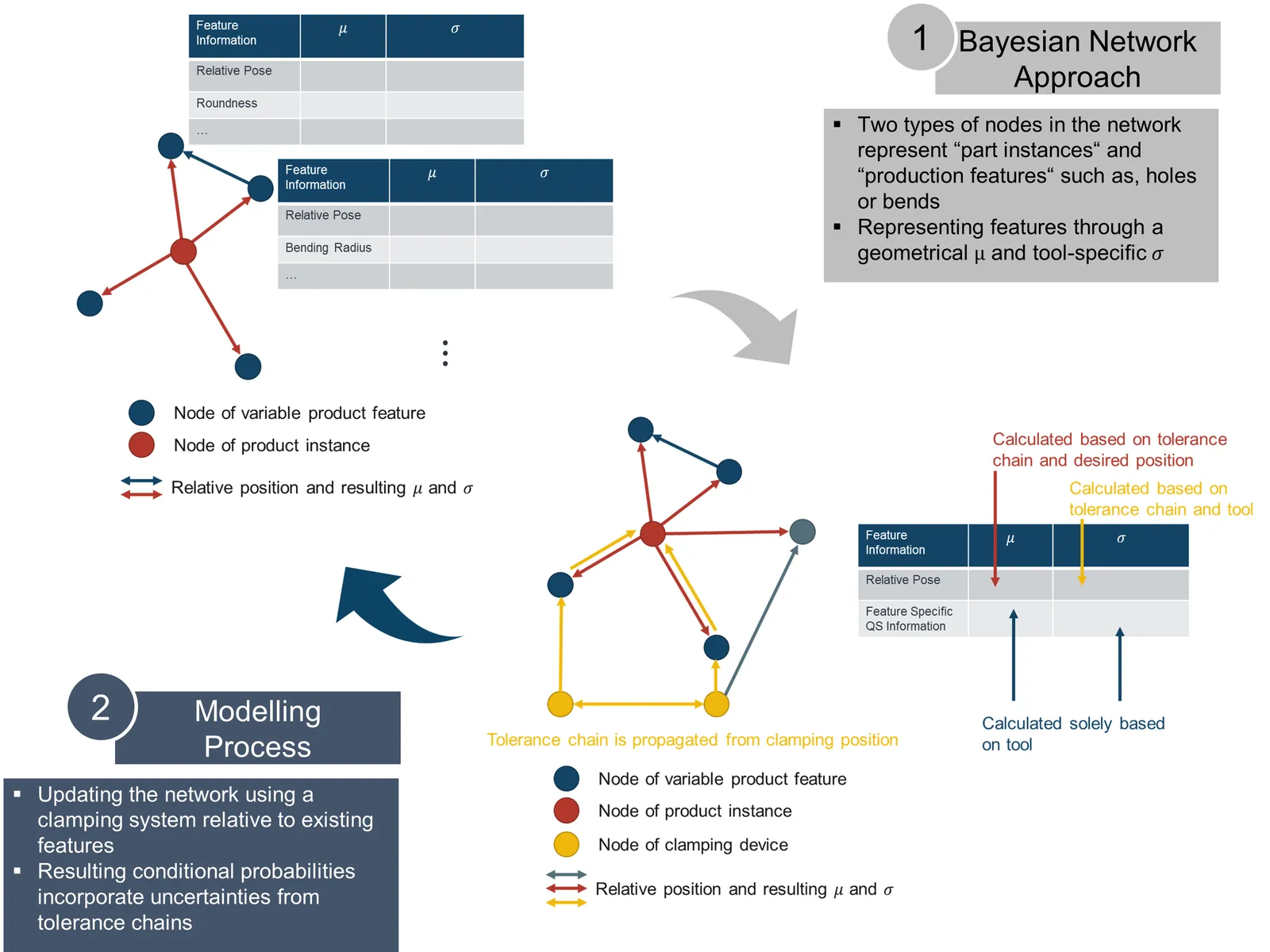
The modular gripper frame was extended to record force, position and angle over time. A generalised product–process–resource information model represents product features as nodes of a Bayesian network and propagates quality uncertainty along the process chain. A physics-based virtual model of the demonstrator was built, and its bidirectional coupling to the real system is being implemented.
 Enlarge figure
 Schematic representation of the generalised product–process–resource information model. Figure: After Bott et al. 2024. Publications
-
Development and validation of a modular and over-instrumented gripper frame for the handling and thermoforming of UD fiber-reinforced thermoplastic tape laminates
Annals of Scientific Society for Assembly, 2026
-
Towards a Generalised Information Modell: A Bayesian Network Approach for PPR-Representation
ICSM 2024, 2025
-
-
T1.2 Process configuration and updating
A planner explores the configuration space of the demonstrator, coupled with a physics-based simulation of its digital twin, and weighs quality, reconfiguration effort and maturity measures. A complementary, quality-oriented approach combines the product–process–resource model with a knowledge graph to assess structural modifications.
-
T1.3 Provision of flexible actuators through robot-based forming
A heated robotic end-effector for single-point incremental forming was built and tested, but this forming step proved infeasible after stamp forming. Instead, post-forming with the actuators of the gripper frame was investigated, and higher gripping forces reduced spring-in, depending on the fibre orientation.
-
T1.4 Realisation of the reconfigurable and adjustable stamp forming process
Besides the demonstrator, the process was set up on industrial-scale equipment with a hydraulic press, where gripper frame, infrared heating, sensor unit and press record time-synchronised data. Forming experiments showed a significant influence of the tensile gripper positions on the formed part, and the tape was characterised for friction, bending and shear to parameterise the T2 simulations.
Publications
-
ESAFORM 2025
-
Composites Part A: Applied Science and Manufacturing, 2026
-
About the subproject
The blocks of the kit are described in a machine-readable way, and a virtual demonstrator of the process is built from these descriptions. Its coupling to the real system is being implemented.
Single-point incremental forming turned out not to work as a second stage after stamp forming. Instead, post-forming with the actuators of the gripper frame was investigated: higher gripping forces reduced spring-in, depending on the fibre orientation.
- Principal investigators
- Researchers
-
- Alexander Bott
- Hannah Decker
- Malte Mehner
- Georg Zeeb
- Host institute
- wbk Institute of Production Science, KIT
Publications 6
-
Planning-Based Decision Space Exploration for Digital Twins in Immature Production Processes
-
LLM-Based Pre-Press Decision Support for an Industrial Composite-Forming Workflow
-
Development and validation of a modular and over-instrumented gripper frame for the handling and thermoforming of UD fiber-reinforced thermoplastic tape laminates
-
Towards a Generalised Information Modell: A Bayesian Network Approach for PPR-Representation